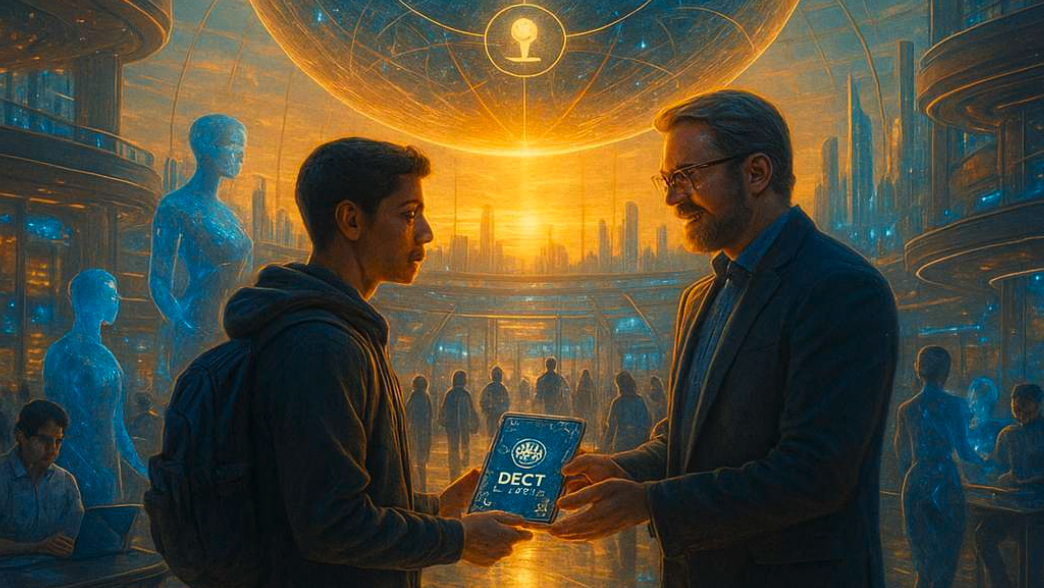

Micro Certification

Creative Intelligence & Digital Futures (CIDF) Program
12-Month Professional Diploma Program

Creative Intelligence & Digital Futures (CIDF) Program

Core Introduction

01

What exactly is the CIDF program?

CIDF (Creative Intelligence & Digital Futures) is a 12-month, industry-aligned, AI-native diploma program designed to train the next generation of:

  • Creative technologists
  • Technical artists
  • AI-native creators
  • Pipeline and production professionals

Unlike traditional media, animation, or design programs, CIDF is built entirely around a real production pipeline, the GCGPS AI+CG Production Pipeline, integrating:

  • Artificial Intelligence (T2I, T2V, T2M, LLMs, AI agents)
  • 3D, VFX, XR, and real-time engines
  • ACES 2.0 + OCIO color science
  • Pipeline governance (AIA, PPS, metadata lineage)
  • Open-source tools (Blender, Godot, Krita, Django)
  • Transmedia storytelling and cultural intelligence

CIDF is not a software-training course. It is a complete creative production system education, mirroring how real studios already operate—and how they will operate in the AI era.

02

Who is this program for?

CIDF is for students who want to work at the intersection of creativity, AI, and technology, including:

  • Aspiring technical artists
  • AI-native filmmakers and animators
  • Game and XR creators
  • Creative technologists
  • Pipeline TD (Technical Directors)
  • Designers seeking strong AI and technical capability
  • Developers interested in creative industries

Importantly:
No prior AI experience is required; no prior 3D or coding background is mandatory; students from art, design, media, computer science, or mixed backgrounds are fully supported.

The program is structured so that all students reach a shared professional baseline, regardless of where they start.

03

How is CIDF different from a normal animation, game, or design degree?

Traditional programs often:

  • Teach tools in isolation
  • Separate art, technology, and theory
  • Ignore production pipelines and governance
  • Treat AI as an “optional add-on”

CIDF is different because it:

  • Teaches the entire production pipeline, not just tools
  • Integrates AI at every stage
  • Uses ACES/OCIO color science, exactly like professional studios
  • Trains students in governance, reproducibility, and collaboration
  • Produces portfolio-level, industry-ready work

In short:
You don't "learn Blender".You learn Blender inside ACES → OCIO → GCGPS → AIA → PPS.

This makes CIDF graduates pipeline-ready from day one, which is extremely rare in education today.

The Zheng He Project: The Cornerstone of CIDF

04

What is the Zheng He Project, and why is it the cornerstone of CIDF?

The Zheng He Project is a real, ongoing, international transmedia IP project, not a classroom exercise or fictional case study. It includes:

  • Cinematic animation and CG production
  • AI-driven character and environment creation
  • XR (immersive experiences)
  • Interactive and game-based content
  • Worldbuilding, narrative systems, and cultural canon
  • Global, multi-studio production workflows

CIDF is deliberately designed around this level of real-world complexity. In simple terms: CIDF is built to train students for projects like Zheng He—not hypothetical student assignments. The Zheng He Project functions as a "living curriculum", continuously shaping how AI, tools, pipelines, and storytelling are taught.

05

Will students actually work on the Zheng He Project?

Yes. Students genuinely work on the live project.

However, participation is:

  • Structured
  • Progressive
  • Educationally designed

Students do not enter core production immediately. Instead, the project is:

Broken into teaching-safe components; integrated gradually across the 12-month program; embedded in coursework, studio simulations, and graduation projects.

CIDF follows five principles:

  • Real IP
  • Real pipeline
  • Teaching-safe decomposition
  • Risk-controlled integration
  • Professionally usable outcomes

This ensures authentic experience without compromising production quality.

06 The Zheng He Project How does it run through the four CIDF phases?

01

Phase I (Months 1–3): Learning Fundamentals Inside a Real World

Students:

  • Study Creative Intelligence and transmedia concepts using the Zheng He world
  • Learn AI concept generation with cultural and narrative constraints
  • Practice Blender, Krita, and Godot using training-level Zheng He assets
  • Understand canon, world consistency, and cultural accuracy

Mindset: "What I learn now will eventually exist inside a real world."

02

Phase II (Months 4–6): From Exercises to Subsystem Production

Students contribute to:

  • Modular environments (ports, cities, ships)
  • Secondary assets and props
  • UI / interaction prototypes
  • AI-assisted textures and variations

Through studio simulations, they:

  • Work in defined production roles
  • Follow GCGPS pipeline rules
  • Use professional naming, versioning, and metadata
  • Learn team-based delivery

Realization: "My work is not just for grading—others may build on it."

03

Phase III (Months 7–9): Cinematic & Immersive Production

Students engage in:

  • Shot-level cinematic exercises
  • AI + CG hybrid workflows
  • Full ACES / OCIO color-managed rendering
  • XR experiences based on the Zheng He world
  • Internal tools or dashboards built with Django

Key insight: Film, XR, games, AI, and web tools belong in one connected system, not separate disciplines.

04

Phase IV (Months 10–12): From Student to Pre-Professional

The Zheng He Project becomes:

  • A capstone anchor
  • A bridge to internships and industry collaboration

Students may work on:

  • Spin-off short films
  • XR showcases
  • Interactive prototypes
  • AI tools or pipeline subprojects

They operate under:

  • Full GCGPS governance
  • AIA (Asset Integrity Assurance)
  • PPS (Production Planning & Scheduling)

Graduates leave with industry-usable work, not "student-only projects."

07

What if my work isn’t good enough—could it harm the project?

No. The program is designed to prevent this.

CIDF uses:

  • Multi-layer production structures
  • Educational buffer layers
  • Selective integration of student outputs

In practice:

  • All work first serves learning objectives
  • Strong contributions may be refined and absorbed into official assets
  • Other work remains valuable portfolio material

Students are never treated as free labor, but excellent students are clearly recognized.

08

What will I actually learn over the 12 months?

Across four phases, students learn:

  • Creative Intelligence (CIE) theory
  • AI systems and multimodal workflows
  • 3D, VFX, XR, and real-time engines
  • Python automation and tooling
  • Color science (ACES/OCIO)
  • Pipeline governance and collaboration
  • Professional production and entrepreneurship

The goal is not software proficiency - but system-level creative capability.

09

What language will be used for teaching?

CIDF uses a dual-language education model:

  • Teaching materials & documentation: English
  • Ensures alignment with global research, tools, standards, and industry documentation
  • Teaching delivery & classroom instruction: Chinese or local language
  • Mandarin, Cantonese, or other local languages depending on location

This ensures:

  • No student is disadvantaged by English proficiency
  • Students gain professional technical English naturally
  • Graduates are prepared for real-world, mixed-language global studios

This mirrors how international creative and technology studios actually operate.

10

How is student performance assessed?

Assessment is project-based and portfolio-driven, including:

  • Essays and research
  • Practical AI and CG projects
  • Studio simulations
  • Group productions
  • Final transmedia capstone
  • Professional portfolio and pitch

There is no single exam that defines success. What matters is your ability to deliver real work in real pipelines.

11

What kind of portfolio will I graduate with?

Graduates typically complete:

  • 1. A playable game or interactive prototype
  • 2. A cinematic CG or VFX sequence
  • 3. An XR experience
  • 4. A full transmedia capstone project
  • 5. An industry internship contribution

This portfolio is comparable to 1–2 years of junior studio experience.

12

What careers does CIDF prepare me for?

Graduates move into roles such as:

  • AI Technical Artist
  • CG Generalist (AI-enhanced)
  • Pipeline TD
  • XR Designer
  • VFX Artist
  • Creative Technologist
  • Interactive Designer
  • Transmedia Producer

They enter studios, XR labs, AI companies, and creative-tech startups worldwide.

13

In one sentence—why is the Zheng He Project the cornerstone of CIDF?

Because:

Future creative professionals are not defined by the tools they know, but by the value they can create inside real systems. The Zheng He Project puts CIDF students into these systems from day one.

If you want, I can next:

  • Turn this into a student handbook chapter
  • Adapt it into a 1-hour recruitment seminar
  • Create a short website FAQ
  • Prepare a parent/ sponsor version
  • Build a CIDF module × Zheng He Project mapping table

Learning and Support

14

How intensive is the workload in CIDF? Will I have time to adapt?

CIDF is intensive by design, but it is also progressively structured. The program does not assume prior AI, 3D, or pipeline experience; workload increases gradually across phases; early months focus on foundation and confidence-building; later months focus on integration and production.

You are never expected to "know everything at once." Instead, CIDF trains you to learn continuously, which reflects real industry conditions. Think of CIDF as professional training, not traditional classroom study.

15

What happens if I struggle in certain technical areas (AI, coding, 3D)?

Struggling is expected, not penalized. CIDF is built on the idea that:
No one excels at everything; creative production is collaborative; growth matters more than perfection.

Support mechanisms include:

  • Modular skill design (you don't fail the whole program because of one weakness)
  • Team-based studio simulations
  • Iterative feedback and revision
  • Faculty guidance focused on problem-solving, not punishment

CIDF does not train "solo geniuses". It trains reliable, adaptable creative professionals.

16

How does CIDF handle teamwork and collaboration?

Collaboration is core, not optional. Students learn:

  • How to work in defined production roles
  • How to communicate across art, tech, and AI domains
  • How to document work so others can continue it
  • How to resolve creative and technical conflicts professionally

Studio Simulation modules deliberately:
Assign roles; rotate responsibilities; simulate real production pressure. You don't just learn what to make - you learn how to work with others to make it.

17

What if I make mistakes or my work fails during production?

Failure is treated as data, not as weakness. CIDF explicitly teaches:
Iteration; debugging; version control; recovery workflows; pipeline resilience.

Because students work inside governed pipelines: Mistakes are contained; nothing "breaks everything"; learning happens safely.

In the creative industry, failure is inevitable. CIDF teaches you how to recover professionally, which is far more valuable than avoiding mistakes.

18

How does CIDF ensure fairness in assessment, especially in team projects?

Assessment is designed to be transparent and balanced. CIDF evaluates:

  • Individual contribution
  • Technical understanding
  • Creative reasoning
  • Documentation quality
  • Professional behavior

Team projects include:
Role definition; contribution tracking; peer and instructor review; clear rubrics. You are not graded simply on "team success," but on your real contribution inside the system.

19

What kind of hardware or software do I need as a student?

CIDF is designed to be accessible while still industry-grade. Core tools are open-source (Blender, Godot, Krita, Django); AI workflows may run on: Institutional servers; shared GPU resources; optimized local setups (where applicable).

You are not required to own high-end hardware at the start. CIDF teaches pipeline thinking, not dependency on expensive personal equipment.

Career Development and Future

20

How does CIDF address AI ethics, responsibility, and cultural sensitivity?

AI responsibility is built into the curriculum, not added later. Students learn:Responsible AI usage; dataset awareness; cultural bias control; canon and historical accuracy; governance through AIA and metadata lineage.

The Zheng He Project especially reinforces:
Cultural respect; narrative integrity; ethical representation. CIDF trains AI-literate creators, not careless AI users.

21

Is CIDF suitable if I want to start my own studio or creative startup?

Yes. CIDF actively supports entrepreneurship.

  • Production economics
  • IP creation and licensing
  • Tool and pipeline design
  • Pitching and presentation
  • Portfolio and personal branding

The program prepares you to:
Join studios; build teams; launch independent projects; create new creative-tech ventures.

CIDF does not train employees only — it trains builders and leaders.

22

How does CIDF stay up to date with fast-changing AI technology?

CIDF is designed as a living system, not a fixed syllabus. Because: Teaching materials are in English; tools are open-source; pipelines are modular.

The program can: Integrate new AI models; update workflows; adjust assignments; evolve alongside the industry.

You learn how to adapt, not just how to use today's tools.

23

What kind of mindset is most important for success in CIDF?

The most important traits are:

  • Curiosity
  • Responsibility
  • Willingness to learn across disciplines
  • Comfort with uncertainty
  • Respect for collaboration

You do not need to be: A perfect artist; a strong programmer; an AI expert on day one. You need to be open to becoming hybrid.

24

What does success look like at the end of CIDF?

Success means you can:

  • Understand and operate inside real pipelines
  • Collaborate with humans and AI systems
  • Deliver work that others can use
  • Explain your creative and technical decisions
  • Continue learning independently

CIDF success is not a grade. It is professional readiness.

25

Final question — what kind of future does CIDF prepare me for?

CIDF prepares you for a future where:

  • AI is everywhere
  • Creativity is infrastructure
  • Boundaries between disciplines disappear
  • Global collaboration is normal
  • Tools change constantly

In that future, the most valuable people are those who can:

Think creatively, work systematically, collaborate ethically, and adaptcontinuously.

That is exactly what CIDF is designed to do.

Want to Learn More Details?

Details can be found in the following PDF files:

English 📄 Simplified Chinese 📄